

Death of Data Analysts
Why AI is slowly killing this role as we know it and transitioning it to analytics engineering
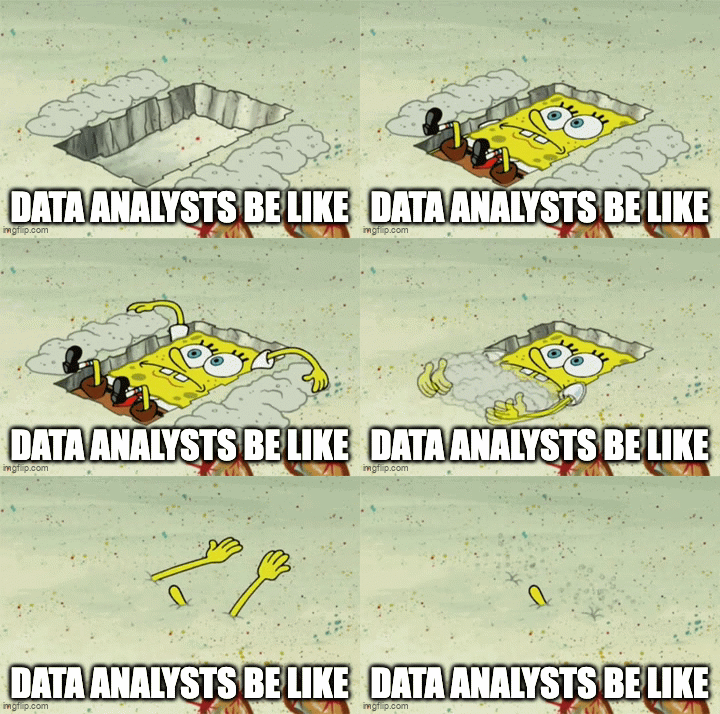
Data analysts will be nonexistent in a few years. Not because their skills aren’t needed, but because there are about to be major process shifts.
Stakeholders will soon turn towards AI tools for answers instead of data analysts. Because, let’s face it, it’s quicker. There’s less of a bottleneck.
They will still need a data person to help them validate metrics and discern the differences between certain numbers, but there’s no longer a technical barrier preventing them from finding answers.
I am already seeing stakeholders’ behaviors change. Instead of using dashboards to make decisions, they are downloading the data from the dashboards and feeding it into Claude to get their own answers.
This is just the beginning.
Today’s newsletter is sponsored by Liquibase.
The best way to support my work is to check out the powerful data governance features offered by Liquibase and book a demo.

The Missing Piece
Now, some of you might be wondering, how can a data analyst be replaced? Data is inherently messy, and there’s a reason stakeholders are still struggling to get the data they need.
A lot of times, they don’t know what they need to measure.
Data analysts provide quick, actionable one-time insights. They help with experimentation. However, a lot of this can be done with AI tooling if the underlying data models are strong and scalable.
If there is a strong support system of data models, most business questions can be answered with the help of AI.
AI models can understand grain. They can read through docs. When given clear prompts, they can use your data models to get accurate answers.
The missing piece for many companies is a lack of this foundational data modeling, which is why data analysts are still around.
Importance of Data Modeling
Strong data models are the foundation of any data work. They allow data and business logic to co-exist. They make sense of all the messy business rules that happen outside of the data.
Business context + data = data models
You can’t have AI adoption of your data without data models that properly model your business processes. Otherwise, AI will be left to make its own logical sense of your raw data.
Data analysts have such strong business knowledge that it would be a shame for them NOT to be involved in this data modeling process. That’s exactly why I don’t think data analysts are going to end up jobless.
They just need to know how to pivot from writing one-off queries to focus on building scalable data models.
Data Analyst —> Analytics Engineer
Data analysts have the deepest business understanding of every data person. This isn’t an easy skill to learn. You need to be REALLY good at communicating.
That’s why it’s such a good one to leverage when switching to analytics engineering. You don’t need to worry about gaining the reps of asking the right questions, probing for the knitty-gritty details, and getting to the root of a stakeholder’s problem.
You just need to focus on the technical aspects, which, ironically enough, AI can help you do.
Here are a few of the mindset shifts you need to move from a data analyst to an analytics engineer:
I find answers to my stakeholders’ problems and find interesting insights. ➡️ I build datasets that model business processes and can be used in many different ways.
I focus on speed and getting results quickly so stakeholders can act on them. ➡️ I focus on scalability so I can adjust my models as business processes change without needing to rebuild everything downstream.
I streamline and calculate metrics that can be used to make business decisions. ➡️ I clean and document data with clear semantics so that it can be used by stakeholders with AI.
Notice how the biggest difference between the data analyst and analytics engineer mindsets is scalability and reusability. Analytics engineers empower everyone around them to become better users of data. They do the heavy lifting with cleaning the data, discovering how it relates back to the business, and transforming it into an easy-to-use data product.
What do you think? Where is the role of the data analyst heading?
PS: I’m thinking about launching a data analyst to analytics engineer course to help you with this career transition. If you’re interested, reply “interested” to this email, and I’ll add you to the waitlist.
Have a great week!
Madison
I am seeing this in my current role. The most impact I can have is the more technical side of things. Just like you state in the post.