

OpenAI is Hiring an Analytics Engineer
How the role is evolving to become more business-centric in the age of AI
In a world where people are panicking about AI replacing their jobs, an analytics engineer role at an AI company seems like the ultimate job security. But actually, it says a lot about the future of the role.
If they aren’t replacing AEs with AI, then who really can?
OpenAI recently posted an Analytics Engineer role on their Go-To-Market (GTM) team. This job description is a testament to how the role is evolving and what skills are becoming even more necessary to stand out in the market.
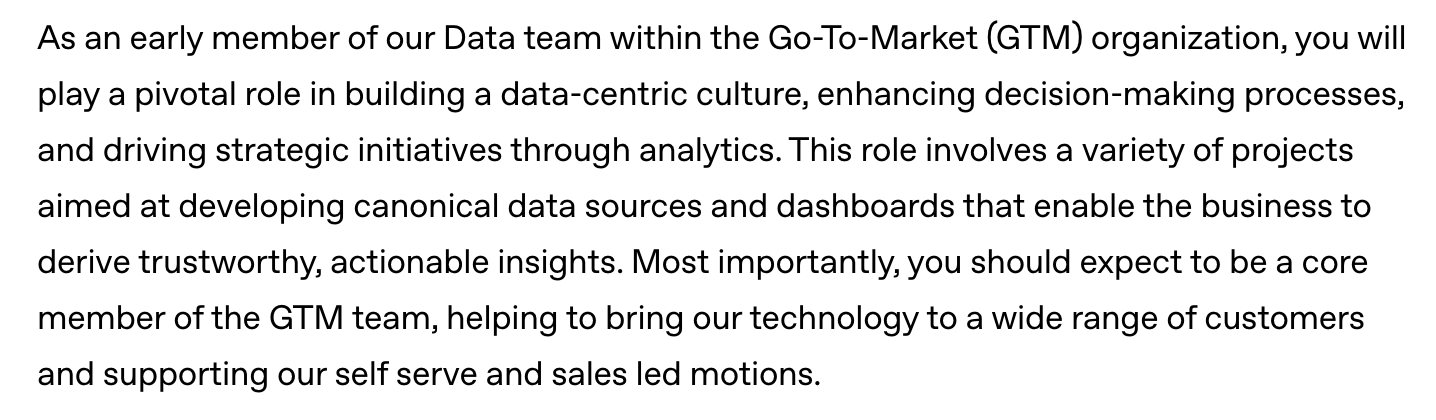
Let’s break down exactly what this means for the future of analytics engineering and where you need to focus your skills so you can continue to provide infinite value in an industry that’s changing faster than ever.
Sure this job description mentions skills like SQL, Python, and data visualization. Most of us know that we need to have a base understanding of these to land any analytics engineering role.
The thing that stood out most to me about this job description was the emphasize on soft skills and being truly embedded into the business. Fostering partnership, driving business impact, and data storytelling are all mentioned as abilities of the perfect candidate.
Embedding with the business
The very first line of the responsibilities section says to “embed with the GTM team as a trusted partner.” Not report to them. Not support them. Embed with them.
In the next few years, we will see a massive shift towards data and business working more as a unit rather than separate teams. I believe this is the only way for the two to truly stay on the same page.
I’ve worked for companies where the business and data teams were so disconnected that we didn’t know what changes were being made to which products, and how those changes were showing in our data. This led to a huge lag in being able to measure the success of products.
With people building at lightening speeds, there is no time for mistakes like this. Data and business teams need to be working step in step, and Open AI recognizes this.
I’ve changed the way I work to try to reflect this. Instead of delivering on one big project after working on it for weeks or months, I’m regularly checking in with my stakeholders and making them a part of the process. Building data models and dashboards shouldn’t be a solo endeavor but rather a collaborative one.
By making an effort to make your stakeholders part of the building process, you will get a more accurate data product, faster.
Driving the definition, tracking, and operationalizing of metrics
Defining a metric sounds easy until you’re in a room where five people have five different answers to “what counts as a conversion.” Building alignment around how a number is defined, calculated, and surfaced is genuinely hard work, and it’s the kind of work that makes an organization truly data-driven.
These are conversations that AI can’t have. They need to be driven by humans. As an analytics engineer, you need to know which questions to ask to get the right information out of people. Most times stakeholders don’t know how they define success until they see how they don’t want to define it.
Analytics engineers will be the one to streamline metric definitions across teams, figuring out the nuances that these teams don’t even know exist. Right now this responsibility is distributed between analytics engineers and data analysts, but metric definitions should inherently come from the data modeling layer, not BI.
I’m a believer that solid metrics come from solid data modeling. You need to have a foundational data model built around a business process before you can create metrics to measure that process. If you don’t have this, you will always run into inconsistent metrics.
This article is a great place to start for improving your data modeling skills.

Crafting clear data stories
Having all of the numbers in front of you is great, but if you can’t relate them back to the business, what’s the point? This is why every data person needs to be able to tell a story with the numbers they produce.
What does increase in expansion MRR mean for the business? What product is the reason for this and where should the business lean into? How can expansion MRR increase but new MRR decrease? Again, what is the data telling us?
These are all important data questions that come back to storytelling. Executives need to know how all of the metrics you are measuring relate back to one another, and where they point to.
This is traditionally a super power of data analysts more so than analytics engineers. It goes to show that analytics engineers can learn from data analysts and vice versa. It’s also one of the many reasons I think data analysts make great analytics engineers.
Sure, AI can tells stories with data, but they are going to be mechanical and pattern-oriented. I’m not sure AI understands human psychology, especially in relation to your business, the same way that humans do. Not to mention all of the context that would be needed on many areas of the business….
To improve at data storytelling, I recommend volunteering to do more analyses and business case studies. This is a helpful thing to do to get into the pattern of using data to support business initiatives. Also, practice simplicity! How can you explain a complex metric in a way that can lead to actionable insight?
The future of analytics engineering
This is a senior role, so don’t let the requirements intimidate you if you’re earlier in your career. Think of it as a roadmap as to where the future of analytics engineering is headed.
Core technical skills still matter, of course, because you need to have discernment, even with AI. I think Open AI recognizes that AI still has a long way to go, but is still a powerful tool for analytics engineers to use in their technical work.
However, soft skills of storytelling, defining metrics, and streamlining the workflow between business and data will become the new standard moving forward. As of now, you can still get away with being a highly skilled technical analytics engineer without proper soft skills, but I don’t think that will be the case in a few years.
Soon, it will be the collecting of business context and understanding how that shapes your data that defines the role of the analytics engineer.
Combining business understanding with technical expertise was always the super power of analytics engineers, but now it’s tipping more towards a more collaborative, value-driven approach.
Capturing business context and encoding that into scalable data models is where analytics engineering is headed.
If you didn’t get a chance to read last week’s post on testing out Cursor for analytics engineering workflows, I highly recommend giving that a read.
And don’t forget to let me know how your data role has slowly been changing as AI increases in popularity!
Have a great week!
Madison
Well said. I've seen a lot of AEs who build metrics on face value without understanding the business context at all. I think AEs have a lot of influence over metrics.. More than they realize. Success of it really hinges on them.
As an AE I’m so glad the business centric part comes naturally to me. Building with the marketing team is crucial to make business sense.